On Building Tools You Wish Existed
Why the best projects start from personal frustration, and why that frustration is a feature.
The best reason to build something is embarrassingly simple: it doesn’t exist, and you want it.
Not “the market needs it.” Not “this will scale.” Just: I kept hitting this wall, and I got tired of it.
That’s how Folio started. I was learning Japanese. I found Genki and Tofugu for the free side. Good materials. But Genki’s audio is separated: you read the book, hit an audio section, then switch to your phone, open the app, find the track. It works (plenty of people learned that way), but for me, it was too easy to get distracted the moment the phone was in my hand.
So I built Folio. Upload your PDF and audio together, study in one place, no switching. Then I found Barbara Oakley’s Learning How to Learn and started thinking about how I was studying, not just what. I added Spaced Repetition (same algorithm as Anki) and a Pomodoro timer. Then I added Anki flashcard import because I noticed people were already using Anki alongside their PDFs. One friction led to another fix. It was never a one-night story.
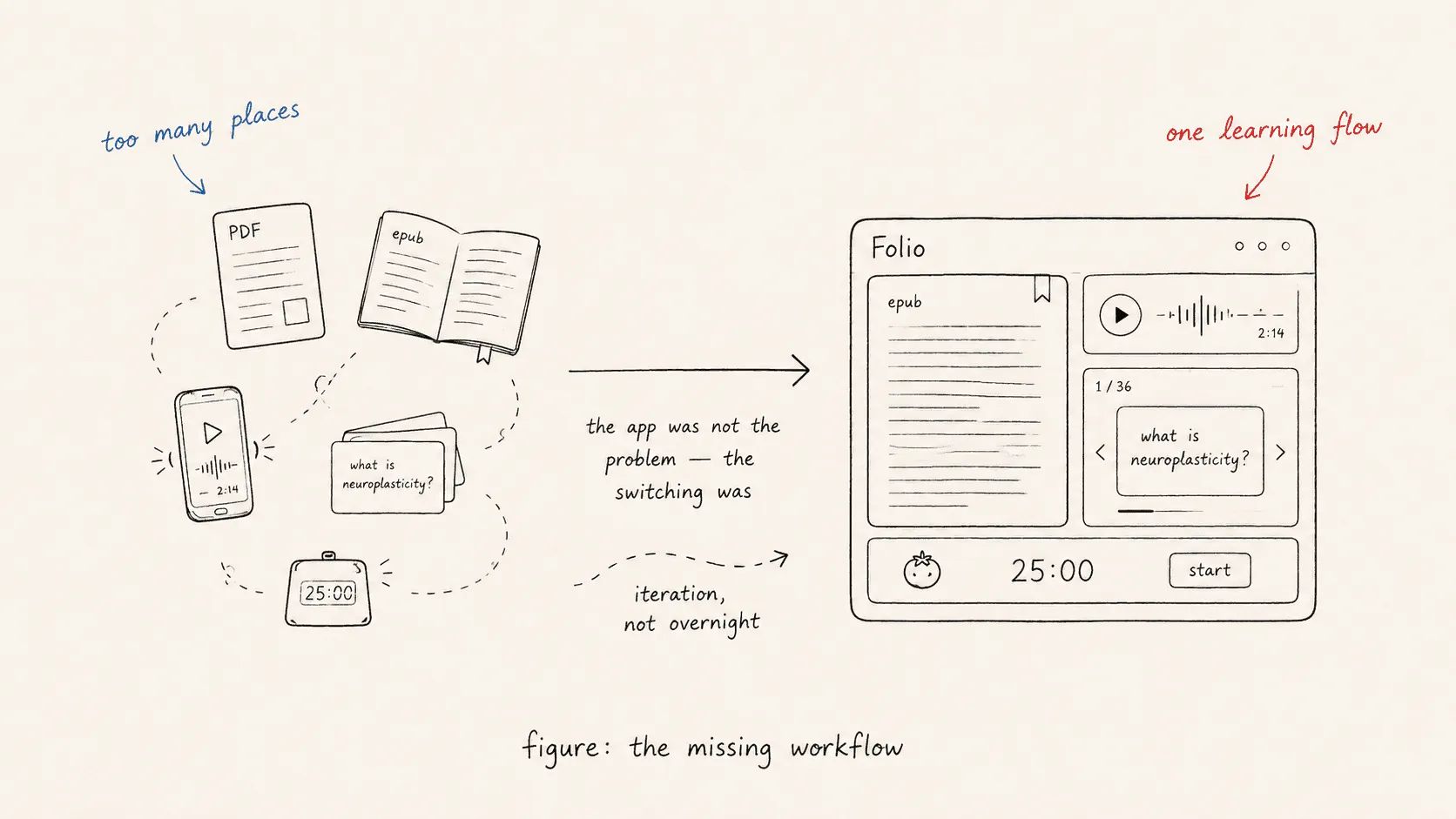
There’s something clarifying about building for yourself. You know exactly when it’s working because you feel it. No user research needed. The frustration is the brief.
The risk is building something only you will ever use. But I think that risk is overrated.
If the frustration is real and specific, if you can articulate why existing solutions fail, then other people probably hit the same wall. They just didn’t build their way out.
Naval Ravikant talks about specific knowledge as the thing you develop by pursuing genuine curiosity, not a curriculum. Building tools you wish existed is one of the more direct ways to do that. You’re not chasing a trend. You’re following an actual itch.
The other thing I’ve learned: a tool built for yourself first tends to be more honest than one designed to impress.
It’s not decorated with features you don’t use. It does the thing, in the way you actually want it done. Building to your own taste is, quietly, a form of quality control.
Build the thing you wish existed. Use it. Then decide if you want to tell anyone.